
Why Most Traders Lose Money
In November 2024, I started a small trading account with just $92.
At the time, I was not thinking much about survival.
Like many traders, I was thinking about growth.
I wanted larger profits, a larger account, and faster progress.
For a while, things went surprisingly well.
The account grew quickly. Some periods felt almost effortless. Looking back today, the equity curve appears impressive for such a small starting balance.
But that chart hides an uncomfortable truth.
There were probably three or four occasions when I came dangerously close to blowing up the account.
Like many traders, I experienced moments where confidence grew faster than my account balance.
And that turned out to be far more dangerous than any market movement.
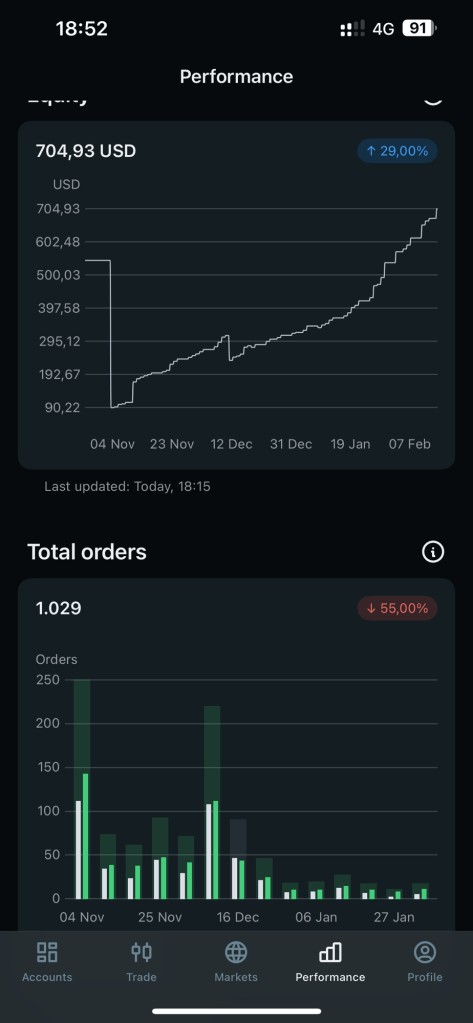
Figure 1. Growth of a small trading account from November 2024 to February 2025. The chart looks smooth in hindsight, but it does not reveal how close the account came to large drawdowns on several occasions.
Looking at this chart today, most people focus on the return.
I focus on something else.
I focus on the times I almost lost the opportunity to continue.
Because over time, I learned a lesson that applies not only to trading, but also to investing, business, and capital allocation:
The first objective is not making money.
The first objective is survival.
The Wrong Question
Most traders enter the market asking:
- What should I buy?
- Which strategy works best?
- What indicator should I use?
- Where should I enter?
These are reasonable questions.
But they are not the most important questions.
A more important question is:
How much can I lose if I am wrong?
In my experience, traders spend far more time searching for opportunities than thinking about risk.
Ironically, risk is often what determines whether they remain in the game long enough to benefit from those opportunities.
A Lesson From Corporate Finance
One lesson I learned long before trading options came from my work in corporate finance.
As a CFO, I have reviewed investment projects, fundraising plans, acquisitions, and business expansions.
Companies rarely fail because of one bad decision.
They fail because they allocate too much capital to the wrong decision.
Too much debt.
Too much concentration.
Too much exposure.
Trading is no different.
The market can forgive a bad trade.
It rarely forgives excessive risk.
Why Traders Really Lose Money
Over the years, I have noticed a pattern.
Most traders do not lose because they lack intelligence.
Most traders do not lose because they lack information.
Most traders lose because they make poor decisions about risk.
They:
- Risk too much on one idea.
- Increase position sizes after a winning streak.
- Trade emotionally after a loss.
- Follow headlines instead of following a process.
- Focus on being right instead of managing risk.
These are not strategy problems.
They are decision-making problems.
The Mathematics Of Survival
One reason survival matters is because losses and gains are not symmetrical.
A 10% loss requires an 11% gain to recover.
A 20% loss requires a 25% gain.
A 50% loss requires a 100% gain.
The deeper the drawdown, the harder the recovery.
This is why professional investors spend more time thinking about risk than most people realize.
Not because they are pessimistic.
Because they understand that survival creates opportunity.
The Shift That Changed Everything
The turning point in my own development was when I stopped treating trading as a prediction game.
Instead, I started treating it as a decision-making process.
Before entering a position, I began asking:
- What is my thesis?
- What am I risking?
- What would make me wrong?
- Is the potential reward worth the risk?
- Am I risking too much capital on a single idea?
The goal was no longer to predict every market move correctly.
The goal was to make better decisions repeatedly.
That mindset changed everything.
The Winvestor Framework
At Winvestor, we believe most investors start in the wrong place.
They start with strategy.
They should start with survival.
Before discussing market forecasts, options strategies, or portfolio construction, investors need to understand:
- Risk management
- Position sizing
- Emotional discipline
- Decision making
Without these foundations, every strategy becomes fragile.
With them, even simple strategies can compound over time.
Final Thought
Every trader has a beautiful equity curve until risk management disappears.
Some curves recover.
Most never do.
The market rewards good decisions more consistently than good predictions.
And that is why I believe most traders lose money not because they have bad strategies, but because they underestimate the importance of survival.
 Systematic options and tactical directional strategies